If you’d like to learn more about the coal mining town of Franklin during its peak, 1885 until 1919, we’ve got you covered. Here you’ll find a list of web resources (and a couple of books and a thesis, too) that will quickly get you up to speed.

Top works of the Franklin mine.
The next Franklin tours are tentatively scheduled for 2021. Come to the Black Diamond Museum at noon to sign up and for orientation. We’ll be leaving at 10 a.m. for Franklin (about three miles). A $5 donation per adult is suggested. Seniors, veterans, and children under 12 are free.
Bring boots, an umbrella, and an imagination.
HistoryLink
Black Diamond and Franklin, as seen in 1902 This article about the east King County coal towns of Black Diamond and Franklin is reprinted from The Coast, Vol. 3, No. 2 (March 1902).
African Americans used as strikebreakers at the Franklin coal mines starting May 17, 1891
On about May 17, 1891, African Americans arrive at Franklin, Washington, to start working in the Oregon Improvement Company coal mines. The Oregon Improvement Company has recruited them from Missouri, Illinois, Kentucky, and Tennessee with offers of good paying jobs and free transportation. It is not until the train arrives at Franklin that the black workers realize they are being used as strikebreakers. The white strikers then do as management has planned: They make a racial issue out of an economic one.
Coal mine fire at Franklin suffocates 37 miners on August 24, 1894
On August 24, 1894, 37 miners die fighting a fire in the Oregon Improvement Co. coal mine at Franklin. The following day, a coroner’s jury rules that the fire was caused by “party or parties unknown” who “did willfully, knowingly and maliciously cause said fire with intent and purpose to do great injury and damage to the lives of the miners and property of the Oregon Improvement Company.”

The Franklin train is ready to head toward Black Diamond.
Franklin Mine disaster (August 24, 1894): A Compilation of contemporary sources
This People’s History consists of contemporary newspaper accounts of the Franklin Mine Disaster of August 24, 1894, and portions of the investigative report by the official state mines inspector. With a death toll of 37, this was at the time the second worst mine disaster in Washington state, exceeded only by the Roslyn mine explosion two years earlier, in which 45 died.
A coal miner’s story—Mike Babcanik’s week trapped underground (1914)
This is an account of a coal mine accident that occurred on February 16, 1914, in the Cannon coal mine, near Franklin, about two miles southeast of Black Diamond, located in east King County. Coal miner Andrew Chernick died in the accident. His partner, Mike Babcanik (1876-1942), was believed dead but survived for seven days trapped underground.
Bess the mule: a coal mining story of 1914
The story of a mistreated mine mule named Bess. Bess worked 24 hours a day without a rest at a Pacific Coal Co. coal mine in Franklin, in east King County. The revelation of the mule’s condition came when a reporter went to the mine to cover the accident.
Smith, John James (1869-1910): Enumclaw doctor, banker, and civic leader
J.J. Smith was employed as a doctor by the coal company during the early years in Franklin, a mining town east of Black Diamond. The elementary school on Griffin Avenue in Enumclaw is named “J.J. Smith” in his honor.
Evans, George Watkin (1876-1951): Washington coal mining engineer
George Watkin Evans started working in the Franklin coal mines on January 9, 1888, at the age of 17. Evans would eventually become an internationally renowned consulting mining engineer.
Who laid those rusty rails?
Morgan Morgans and P.B. Cornwall needed the Columbia & Puget Sound rail line extended from Renton up the Cedar River valley to Black Diamond. They struck a deal with Henry Villard and railroad construction began in 1882. The narrow-gauge railroad reached Black Diamond on December 12, 1884, and then connected to Franklin.
Washington State Historical Society
Franklin and the Oregon Improvement Company
Spring 1994
Henry Villard launched the Oregon Improvement Co. in October 1880 as part of his grand scheme to dominate the development of the Pacific Northwest. By 1883 he had tied the area to the national economy with the completion of the Northern Pacific Railroad. Expansive development of the Pacific Northwest seemed assured.
Black Diamond History Blog
Still driving them out
February 11, 1886
A gentleman came down from Franklin yesterday morning and induced the Franklin miners to join them for the purpose of driving the Chinamen out of Carbonado.

Drawing of Franklin, circa 1887.
A mining town: What a reporter saw at Franklin in this county
August 12, 1888
A community where constables and officers of the law are not needed. Remarkable progress and substantial prosperity.
To smother the fire: The effort to put it out by flooding abandoned
December 14, 1888
No change for better or worse was reported from the Franklin coal mine fire yesterday…. The fire is in the lower McKay tunnel, and has been located in a worked out “breast.”
Something about Franklin
January 8, 1891
Two miles beyond Black Diamond, on the Columbia & Puget Sound Railroad, is the Oregon Improvement Company’s Franklin Mine and the town of Franklin on the Green River.
Franklin strike
May 1891
In the fall of 1890, a bitter strike was raging in the Franklin mines. Company officials decided to send mine superintendent T.B. Corey to the Eastern U.S. to recruit black, out-of-work miners.
Thugs and men: Strikers and Pinkertons at war
June 29, 1891
The first bloodshed of the mining troubles occurred at Franklin on June 28, and two companies of militia have been dispatched to the scene to prevent the race war which seems imminent.
Quiet at the mines: A condition of armed peace maintained
June 30, 1891
The tragedy of Sunday, June 28, 1891, is still the all-absorbing topic of conversation, and though there has been no further violence the bitter feeling is still intense, and violence may occur again at any time.
Terrorized miners
by W.A. Ryan, July 1, 1891
Tacoma Daily News correspondent writes about the desperate encounter between locked out miners, black strikebreakers, and company guards at Franklin.
To the front – Troop B has been ordered to the mines
July 3, 1891
Militia companies G and C, of Tacoma, are off for the scene of the mining troubles at Franklin. Captains were instructed to proceed immediately with their respective companies to Newcastle and Black Diamond.
Citizen soldiers – Sergeant Davis ordered to arrest them
July 6, 1891
There is no indication that there will be any trouble in disarming the miners at any of the camps where trouble has occurred. The indications are that the blacks at Franklin will endeavor to conceal their arms and thus retain possession of them.
Franklin mine flooded
February 28, 1893
Work in the Franklin mines has been interrupted during the past week by water which has flooded the pit and far exceeded the capacity of the pump.
The company exonerated – The feeling against Park Robinson was very bitter
July 2, 1895
Mine Boss Park Robinson was one of the instigators of the Franklin violence in 1891, accused of killing two white miners during the strike. Robinson died in a Franklin mine explosion in 1895, due to his own carelessness.
O.I. Company answers: Says the Italians died because of carelessness
September 26, 1895
Andrew F. Burleigh, as counsel for the Oregon Improvement Co., filed answers in four more suits which have been commenced against the company for the August 24, 1894 mine fire.
Unfortunate boiler explosion at Franklin mines
October 4, 1895
One of the boilers in a battery located at the edge of Green River, far below the mine proper, exploded and killed Phil Early and Romulous Gibson.

The Washington State Militia was called out to the Franklin mines in July 1891.
Slope is on fire: Three men supposed to be dead at Franklin
October 17, 1895
The whole town is wild with excitement and every man is endeavoring to put out the fire by shoveling dirt into the mouth of the burning slope.
Bodies of the four victims may never be recovered
October 18, 1895
The bodies of the four men known to have perished in the slope fire at the Franklin coal mines have not been recovered and the fire has not yet been extinguished, although the flames have been got under control and the slope closed up with timbers, sand, and dirt.
At Franklin all is quiet—the bodies not yet recovered
October 23, 1895
The Oregon Improvement Company’s coal mine at Franklin has been closed down and sealed in order to smother the fire which occurred in the main slope and in which four men lost their lives.
At Franklin Mine: Workmen busy clearing out the main slope
December 7, 1895
The main slope of the Oregon Improvement Company’s mine at Franklin, which has been closed since the recent disaster, has been opened to the sixth level, and before the end of the present month will be again in condition for the taking out of coal.
Remains of the four Franklin miners recovered
December 11, 1895
B.F. Bush, general superintendent of the Oregon Improvement Co., received word today from Franklin that the bodies of the four miners who lost their lives in the mine fire of October 17 last had been recovered. The bodies were almost incinerated, but were identified by articles and particles of clothing found on the bodies.
The work at Franklin: New mine has been opened and work is progressing in the old
December 12, 1895
Since the bodies of the four miners, who lost their lives in the mine fire at Franklin October 17 last, have been recovered, the strain on the nerves of the workmen of the mine has been relieved and the miners have now but one object in view—the reopening of the mine.
Fire in the Franklin Mine
November 11, 1901
“Flames were discovered in Mine No. 7 of the Pacific Coast Co., at Franklin at 4 o’clock yesterday morning,” reported the Seattle Post-Intelligencer. “The miners at work, with the exception of one man, fled to safety.”
Constable of Franklin is ready to surrender
August 1, 1902
J.P. Morris, of Franklin, believes he’s failed in his efforts to control vice and crime in his own community and now it’s up to the highest peace officers of the county to take a hand in the game.
Correspondence between J.C. Ford and H.W. Cannon
November 10, 1903
On November 8, 1903, a locomotive derailed at the Franklin Wye. “Damage not serious except the killing of two men,” reported Pacific Coast Co. VP-GM J.C. Ford to Chairman H.W. Cannon.
A picnic
by Violet Maxwell, January 8, 1905
The short story, “A Picnic,” was submitted to a Seattle P-I children’s contest and, while Violet Maxwell, age 15, of Franklin, didn’t win one of the prizes, her story was published in the paper.
Black Diamond and Franklin, Wash.
May 1905
Black Diamond and Franklin mines, which are located in King County, Washington, and owned and operated by the Pacific Coast Company, of Seattle. From The Coast magazine.
Among cities and towns of Washington: Black Diamond and Franklin
June 1, 1906
June is the month and summer is the time in which to take a trip to Black Diamond and Franklin for then the trees are green and blooming flowers fill the air with pleasing odors; for then the sportsman can whip the fish-filled Green River and lure the gamey trout from placid pools to repose within his basket.
Hired assassin loses his nerve at crucial time
June 16, 1911
Fifty dollars is the price of a human life according to the remarkable disclosures of Joe Cosenza, a Franklin coal miner whose life was spared by the weakening of the hired assassin.
Midnight fire does damage at Franklin
April 21, 1913
A disasterous fire which started in the general store of the Pacific Coast Coal Co. at Franklin, at the terminus of the Columbia & Puget Sound railway, destroyed the store and contents and swept away the railway station, the store’s warehouse, and five dwellings occupied by miners’ families.
Fire sweeps little mining town during early morning
June 26, 1913
The hotel building belonging to the local coal mining company and 21 frame dwelling houses were destroyed by fire. The loss to the hotel and contents is about $16,000. This is the second disastrous fire within two months.
Poor condition of locals is their loss: Franklin miners win soccer game from Nationals
February 16, 1914
In the soccer game with the Franklin miners at Athletic Park, the Tacoma Nationals played a brilliant game up to the very finish; then they blew up for a moment and before the game ended the visitors had put the ball squarely between the goal posts three times in succession, winning the game 3-0.
Miner who was buried alive for more than week, and family that is reunited by rescue
February 24, 1914
Seven nights and six hours were spent in a living tomb by Mike Bobcanik, a Franklin coal miner, who was rescued alive from the Cannon Mine.
Veteran jewels given to Knights of Pythias
June 1, 1914
Veteran jewels of solid gold, handsomely decorated and inscribed, were conferred with special ceremony here Saturday night upon five Knights, who have been twenty-five years in the Pythian order.
Steel bridge at Franklin opened
April 11, 1915
With the completion and opening to traffic of the bridge over Green River at Franklin last week, the most important and most expensive unit of bond road project No. 9 has been completed by County Engineer Arthur P. Denton and his force.
Efficiency in coal dumping
May-June 1916
A method of dumping coal, as it comes from the mine, into the bunkers, that is the last word in efficiency, was conceived and developed by R.R. Sterling of the engineering staff of the Pacific Coast Company.

Dirty job: Franklin miners, ca. 1915.
Newcastle and Franklin houses being secured
February 15, 1922
Following the action of the former employees at Black Diamond with respect to vacating the dwellings on company property, as reported in the Bulletin of January 18, the former employees at Newcastle and Franklin have decided to take similar action.
Franklin Mine suspends operations
February 22, 1922
The company reported in its weekly newsletter, the Pacific Coast Bulletin, that it was suspending operations at Franklin Mine. The reason is the company’s inability to market Franklin coal until larger and more washing facilties are provided.
Pacosco dance best ever
by Glen Clancy, February 22, 1922
On Saturday, February 11, the Pacosco Club [Franklin] entertained with a Masquerade Ball and Clancy remarked that the affair was a real “Cannon Ball.”
Veteran coal miner talks to Central Council
October 1, 1925
W.T. “Bill” Thomas, a miner in Franklin in the late 1880s, described the occasion when he, with sixteen others, were entombed in the Franklin Mine behind a raging fire.
Mother’s concern sparked mine radiation-shelter plan
by Marshall Wilson, March 19, 1959
Mrs. Ronald Frazier, civil-defense worker in Black Diamond, inspected Franklin Mine, which will be King County’s first radiation fall-out shelter. The mine, which will hold 3,000 persons, would also protect against a nuclear blast.
The awful disaster at the Franklin mine
by Frank Lynch, May 3-4, 1961
A regional folk song and a regional hero…. “The Disaster at Franklin.” Learn about the August 24, 1894 fire at Franklin and story of John Johns and his son, Evan, who lost their lives in the mine.
Franklin: It’s about as ‘lost’ as a town can get
by Lucile McDonald, September 3, 1961
One of the most thoroughly “lost” towns in King County is Franklin, 3 miles east of Black Diamond. You can drive through it, just before crossing the high bridge over Green River Gorge, and never know the place is on the map.
New-type explosives close last mine in Green River Gorge
by Wini Carter, March 27, 1971
Three explosions on the morning of March 27, 1971, reverberated from the deep canyon of the Green River Gorge, closing a shaft and destroying a bridge leading to the last operating coal mine in the Franklin area.
Planned blast closes Number 10 coal mine
April 1, 1971
We have another article, this one from the Enumclaw Courier-Herald, about the closing of the Number 10 Franklin coal mine tunnel and airshaft in 1971.
Underground mine fires in Black Diamond area hazardous for tourists
by Noelle Fingerson, ca. 1972-73
Two fires are presently burning in the area near the abandoned townsite of Franklin, three miles east of here. Both fires are burning in the No. 12 seam of the old Franklin Mine, but they are separated by the Green River.
History of the coal mines in Franklin
by Chuck Holtz, January 1977
This blog post summarizes the early history of the coal mines of Franklin.
Mining town that vanished forever
October 1977
The town of Franklin literally hung over the the Green River, 400 feet above the churning water. Space was always at a premium and the main part of town was strung out along the edge of the railroad track.
Miner Frank
November 13, 1981
Miner Frank Grens, about the only resident left in the old mining area of Franklin east of Black Diamond, puts on a pot of coffee in his one-room shack, formerly a miner’s wash house.

Dr. James Tate Mason
Dr. James Tate Mason
May 1985
Did you know that Dr. James Tate Mason, the founder of Virginia Mason Medical Center in Seattle, got his start as coal company doctor here in Black Diamond and Franklin?
Franklin memories
by Ann Steiert, November 1985
Franklin in the last years of the 1880s represented a typical coal camp: A company town connected to the outside world by a railroad and telegraph line.
Black history buffs tour area mine sites
by Eulalia Tollefson, May 7, 1986
Noted persons from the Seattle black community recently toured Black Diamond and the old Franklin site “to get a feel of what life was like in a mining town.” They were joined by state and local historians and historical society members.
Agneta Slott’s memories sketch heyday of mining
by Barbara Clements, August 1, 1986
At 90, Agneta Slott’s hazel eyes are clear and her wit sharp as she recalls her girlhood days in Franklin, once a thriving mining town.
Students find old mining town artifacts
by Danny Westneat, July 7, 1991
Coal miners stopping for a drink at Jack Hyde’s saloon in the old mining town of Franklin apparently had more chance of finding a gunfight than a good deal.
Don Mason brings mining town’s glory days to life
by Mike Archbold, February 3, 1994
The year was 1976 and Don Mason was making his way on foot to the old Kent pioneer cemetery. That’s where he came across the grave of John Hall. The marker simply said he died in the Franklin mine disaster in 1894. But, Don wondered, where was Franklin? What mine disaster?
Students unearth forgotten mysteries of a historic town
by Keith Ervin, February 11, 1994
Hidden beneath the maples and cottonwoods of the Green River Gorge are secrets unseen by the casual visitor. Some of those secrets are a little more visible today than they were yesterday, thanks to eighth-graders from Cedar Heights Junior High School in Covington.
Students bring ghost town back to life
by Lyle Price, February 14, 1994
Although Franklin is just a memory and a brush-overgrown ruin lost on a hillside above the Green River, the town is coming alive in the minds and imaginations of students from Cedar Heights Middle School.
Franklin’s history comes alive in class
by Jami Leabow Farkas, May 18, 1994
Not much sits now on the land off Southeast Green River Gorge Road near Black Diamond. It’s barren, save for huge trees and a few headstones that give clues to the people who inhabited the once-thriving coal mining settlement of Franklin.
Memories of our mother
by Regina Marckx Whitehill, December 1996
Read what it was like to live in Franklin, circa 1913. Regina Marckx Whitehill’s dad, with the help of her brothers, built a home at Franklin on property purchased from the Pacific Coast Coal Co. The property was once the mule pasture when mules were used to pull coal cars out of the Franklin mines.
Hike to Franklin
by Cory Olson, January 2002
Twenty-five people met at the museum to go on a hike up to visit Franklin. We drove to the flats just below the old Franklin town site. It was there that our tour guide, BDHS President Don Mason, brought out his collection of Franklin photographs, which had been enlarged to the size of posters.
Lamp holds story of local mine tragedy: Father rushed to save son, died with him, 35 others in underground fire
by Gordy Holt, Janaury 6, 2006
One by one the graves were dug. They split the ground of cemeteries from Black Diamond to Newcastle, Renton and Seattle to hold the 37 victims of an 1894 explosion and fire that raged inside a Black Diamond hillside and is remembered today as the Franklin coal mine disaster.
Franklin: An educational experience from the past
by Frank Hammock, April 2006
Nestled in silence along a hillside 3 miles southeast of Black Diamond, Washington the forgotten remnants of an historical town once stood that was busy and teamed with life. Few people know of its existence and even fewer know of its significance to Washington’s history. In fact, driving by the area one would never even know that a town of over 1,000 people once existed there because its current location is severely obscured by trees and underbrush, and there are no signs that betray its hidden presence.

This unidentified youngster is standing on one of the three “frogs,” or switches, that make up the Franklin Wye.
Bridge over the River Green
by Frank Hammock, January 2010
It’s made of stringers, portal struts, top and bottom chords, top and bottom lateral bracing, sway bracing, portal and counter bracing, diagonals, inclined end and vertical posts, floor beams, and panels.
John D. Jones (Jac Y Cigydd – Jack the Butcher)
by JoAnne Matsumura, April 2010
John D. Jones emigrated to Franklin in about 1885 at the age of 39 and joined the other miners picking coal. Jones was a noted singer of Welsh ballads and verse in the Cambrian tongue, and performed at the 1886 Eisteddfod in Black Diamond to a crowd of nearly 4,000.
Why doesn’t a wye look like a Y?
by Ken Jensen, April 2010
How did trains turn around in Franklin? The short answer is that they didn’t. Trains were always backed into Franklin and then, once loaded with coal, were pulled into Black Diamond.
History of a mining community
by TJ Martinell, May 13, 2011
“I have to admit, when I first went to Black Diamond, I didn’t think I’d be introduced to the mayor of a ghost town,” wrote reporter TJ Martinell. “When I first spoke to Keith Watson, director of the Black Diamond Historical Society, I expressed my interest in Franklin, the nearby ghost town. After discussing how to get there, he looked at me with a subtle grin and asked, ‘Do you want to meet the mayor?’”
Nothing touristy about Franklin
by TJ Martinell, May 20, 2011
“When I think of a ghost town, a tableau of the iconic ‘High Noon’ spaghetti-western comes into mind,” wrote reporter TJ Martinell. “As I explored the area near Green River with Dan Hutson, a member of the Black Diamond Historical Society, where the town of Franklin once was, I perceived that, as a ghost town, it has none of these qualities.”
Herman Wicks dies in Franklin Mine in 1906
By Byron Wicks, Fall 2013
Herman Oscar Wiikus (changed to Wicks) was born in Finland in 1874 and emigrated to the U.S. in 1901. He ended up in Franklin, working in the coal mines with other Finnish immigrants. He was a single man, but would not remain so for long. He married Emma Iljana in 1902. Herman was killed in the mine July 24, 1906. He was 31.
The gentle, compassionate, and likable ‘Big Krit’
by JoAnne Matsumura, Fall 2013
Henry Edwards, better known as “Big Krit,” arrived in Franklin in the late 1890s and began working for the coal company in various capacities. He lived on Marckx Farm Road along with other African-American families clustered near the school house.
The lamp survives, yet John E. and Evan John perish
By JoAnne Matsumura, Fall 2013
Six generations and 119 years later, a safety lamp still lives on. It was found unscathed by the bodies of John E. John and his son, Evan, who were clutched in an embrace in the aftermath of the tragic Franklin mine disaster of August 24, 1894.
Romantic engagement on the rocks
by JoAnne Matsumura, February 14, 2014
In spring it’s said a man’s heart turns to romance, and for Jesse Story, he was smitten with Margaret Ramsey. Planning a romantic proposal of marriage in 1894 must have been challenging, but with the Green Rivers’ picturesque Bridal Veil Falls, what more could one want. The falls, near the historic town of Franklin, once featured an observation deck and steps to a narrow footbridge.

The Franklin post office opened November 9, 1886. This photo is circa 1920.
Treasures from the earth speak
by JoAnne Matsumura, February 27, 2014
In the archaeology study of Franklin conducted by Gerald Hedlund and Mark Vernon in the 1980s, an Asian coin was found in the form of a belt buckle—an object that was probably significant to its owner. The coin was a most unusual find. For more about the archaeology study of Franklin, check out the book, From Smoke to Mist.
Ten cents a ride
by JoAnne Matsumura, March 30, 2014
Jack Willan (Brady) spent two of his high school years at Black Diamond High, 1920-1921. “Most of it was hiking back and forth from Franklin,” he said. “We did have tickets on the train … [for] ten cents a ride.”
The ‘other’ Franklin: One survives; one lived hard and died young
by JoAnne Matsumura, November 9, 2014
Historic Franklin was perched high on the edge of a deep ravine in a beautiful setting. A river, far below, meanders among boulders, creating pools that entice anglers, swimmers, and kayakers alike. But did you know there’s another Franklin?
Life after mining: The Ernie Moore story
by JoAnne Matsumura, February 15, 2015
He was an owner of a coal mine, a pump man, and a mule skinner. He once took a job in a foundry and another paving asphalt roads. He was Ernie Moore, an African-American, third generation coal miner born in Franklin.
Franklin Hot Springs: A brief history
by William Kombol, Summer 2015
After the Franklin #12 mine closed in the 1970s, the coal seam caught fire and burned underground. Water streaming out of the mine was heated by the burning coal, creating Franklin Hot Springs.
Franklin: A short story
by William Kombol, Winter 2016
The town of Franklin was developed for coal mining and operated as a company town from around 1885 to 1922. At its peak there were approximately 1,100 people living and working in Franklin.
When Coal Was King by Bill Kombol
Fulton #12 surface coal mine
May 29, 2007
In this February 1951 photo on Franklin hill east of Black Diamond, a large P & H shovel and a bulldozer are working on top of the Fulton #12 coal seam that pitches at about a 45° tilt into the earth’s geology.
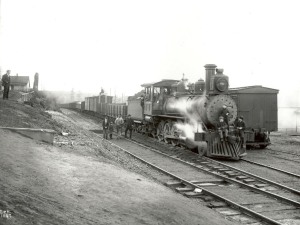
Three boys sit on the locomotive’s pilot, while several men and boys stand on the railroad track in this 1902 photo of Franklin.
Loaded coal train at Franklin, 1902
November 13, 2007
In the early days of coal mining, almost all of the coal was transported to market by railroads. This coal-fired steam engine would have been a familiar sight to those living in the coal mining towns and camps, as well as the dock workers where much of the coal was re-loaded on ships.
Homes in Franklin
March 11, 2008
As was common in coal mining towns, the homes were originally the same design and built in an assembly line fashion. This 1902 photo shows a string of homes in Franklin with a group of children posing for famed photographer Asahel Curtis.
Picking table of the Cannon Mine in Franklin, ca. 1913
April 1, 2008
A picking table was typically a moving conveyor or the deck at the end of a vibrating screen where miners separated the good, clean coal from the shale and rock.
Operations of the Fulton surface coal mine
April 15, 2008
Jack Morris and John H. Morris examine a front shovel that is shown excavating the uncovered Franklin #12 coal seam on Franklin hill in May 1950. Pete Zavattero stands to the right.
Overhead track, bunkers, and topworks of the Franklin No. 1
June 3, 2008
In the early days of coal mining it was important to bring the coal out of the mine and get it to a sufficient height so as to allow gravity to be an important tool in the subsequent processing of the coal. This tipple in Franklin, as it was called, allowed coal to be brought out of the mine in coal cars to the top of the bunkers.
‘Bess’ the mule
September 16, 2008
One of the most fascinating stories to come from the Franklin coal mines involved a mule named ‘Bess,’ who was employed at the Cannon Mine on the banks of the Green River.
Franklin No. 1 Coal Mine
November 18, 2008
The coal miner who is shown was called a “rope rider” as he would ride the coal cars pulled by a steel cable (the “rope”) into and out of the mine. At the bottom of the mine the rope rider would couple the cable to the coal car and then ride the car to the outside portal (i.e. entrance) to the mine.
Franklin Hotel
April 16, 2009
A hotel in a coal mining town was more of a room and boarding house for single men who worked in the mines. Married men with families typically lived in homes provided by the coal company.
Cannon Mine coal bunkers
March 2, 2010
The Cannon Mine was named in honor of Henry W. Cannon, a former president of Pacific Coast Co. who served as chairman of the board of directors. Driving the gangway for the Cannon mine commenced on the Gem coal seam in 1910.
Ernie Moore
January 16, 2012
The late Ernie Moore was the author of “The Coal Miner Who Came West” (1982) about his African-American family’s experiences in Franklin.

Mine No. 7 produced coal until 1907 when it was shut down and the rails taken up. During the early years of World War II, the mine was re-opened by Pacific Coast Coal Co. and later operated by the Strain Coal Co.
National Guard at the Franklin coal mines, Franklin, Washington; July 1891
January 23, 2012
The Franklin coal mining community in the late 1880’s and early 1890’s was a raucous scene filled with work stoppages, company lockouts, strikebreakers, and violence.
George Watkin Evans
December 18, 2012
“Son, here is imprisoned sunshine that warmed a swamp which stood here millions of years ago.” So spoke a Washington state coal mine inspector to the 17-year-old George Watkin Evans, who was working in the Franklin coal mines in the early 1890s.
Top works of the Gem coal mine
January 29, 2013
The Gem Coal Mine (1912) was operated by the Pacific Coast Coal Co. in Franklin. At the end of World War I, coal prices declined precipitously and the town came to an abrupt end.
Franklin Mine No. 7
January 27, 2014
Mine No. 7 was located about one mile north of Franklin. It was served by the Bruce Branch of the Columbia & Puget Sound Railroad, which paralleled the Green River Gorge Road and ended just south of Lake 12.
Excavated Fulton coal seam east of Black Diamond
February 25, 2014
The Franklin #12, better known as the Fulton seam, was mined from the surface. The two cables near the top of the photo were used to operate a drag line to pull loose coal from where the lone miner is standing.
Green River Gorge Bridge
March 25, 2014
The high bridge spanning the Green River Gorge, a famed and scenic site located between Cumberland and Black Diamond, was built in 1915. The bridge, now a single-lane design, is still in service more than 100 years later.
Franklin No. 10 mine
April 1, 2014
The last coal mine on the Green River Gorge was blasted shut with powerful explosives on March 27, 1971. The press gathered on the banks of the Green River as 900 pounds of the experimental dynamite, called Astrolite K, was placed inside the mine portal and on the mine bridge across the river.
Vista to behold: Bridge over the Green River Gorge
April 8, 2014
The single-lane bridge over the Green River Gorge is a vista to behold as you cross 150 feet above the river, and even more remarkable when looking up. The bridge was built in 1915 to replace earlier wooden crossings that served the nearby coal mining town of Franklin.

The high bridge across green river gorge, a famed scenic site located between Enumclaw and Black Diamond was built in 1915.
Cannon Mine in Franklin
February 3, 2015
The Cannon Mine operated on the Gem and McKay coal seams, both lying on the east side of Green River. A bridge was constructed to bring coal across the river. It was then hoisted up an incline to coal bunkers near the Columbia & Puget Sound Railroad.
Massive slide near Cannon Mine bridge
February 17, 2015
This photo dates to the late 1940s or early ‘50s and shows the Cannon Mine bridge, which to this day carries Black Diamond’s water supply. The massive slide almost wiped out the city’s facilities.
Green River Gorge
March 3, 2015
The Green River Gorge is a wonderful geological feature to behold. Through millennia, the river has cut a channel deep into the bedrock, allowing early explorers to easily find the coal seams which occurred near Franklin.
Inside the Franklin railway station, September 1909
February 2, 2016
Today’s population has little comprehension of the world that existed before the advent of modern communication. A century ago life in a remote coal mining town, such as Franklin, was carried on without telephone, radio, or television, and certainly no texts or Internet.
Inside the Franklin company store
March 1, 2016
Company stores, like this one in Franklin, were touted by mine owners to attract workers to remote towns. Without decent housing, stores, and schools, a mining company would have little luck in persuading laborers to live and work in their communities.

A fire destroyed the general store and swept away the railway station, the store’s warehouse, and five dwellings occupied by miners’ families in 1913.
Green River Gorge Bridge and Bridal Veil Falls
May 24, 2016
Check out a photo by Clark Kinsley that shows the Green River Gorge Bridge and Bridal Veil Falls, ca. 1923. It comes courtesy of his grandson, Ron Kinsey, and was tinted by his grandmother, Mary Jane (Williams), a Welsh immigrant to Black Diamond who married Kinsey in 1898.
Franklin No. 12 served as fall-out shelter
January 30, 2017
During the US-USSR Cold War, Mrs. Ronald Frazier’s concerns for her two children led her to seek a suitable radiation fall-out shelter in case of nuclear war.
Civil Defense volunteers at Franklin No. 12
February 28, 2017
Volunteers in 1959 are shown building approaches to the Franklin No. 12 coal mine so it could be used by local residents in case of nuclear attack.
Photos of the Green River Gorge bridge never cease to amaze
April 25, 2017
The Green River Gorge Bridge was constructed in 1914-15 to provide a better link for the historic coal mining town of Franklin, established 30 years earlier. By 1929, a vibrant resort operated on the east side of the river.
Maid of the Mist
July 9, 2018
This Ellis postcard #3518 is labeled Maid of the Mist at the Green River Gorge and probably dates to the 1920s. Since 1885 when the nearby coal mining town of Franklin was developed, the Gorge has been a popular tourist destination.
Frank Grens
February 5, 2019
Of all the colorful characters who populated the coal mining towns of King County, perhaps none was more colorful than Frank Grens. He was the subject of a number of newspaper articles in the late 1970s and early 1980s. He lived in an old miners’ washhouse on a high bank overlooking Green River Gorge.
Franklin was a bustling company town
February 19, 2019
Franklin was a bustling company town perched above the Green River Gorge with all the spectacular beauty that wonder of nature had to offer. Coal was the town’s purpose but the miners and their families who extracted those black diamonds had to be housed.
Two-story home built in the coal mining town of Franklin in 1910
February 28, 2019
This home was built in 1910, and was located on the Franklin Depot Road not far from the historic town site. In 1945 the home and property were purchased by Water District 66, the predecessor to the Black Diamond Water District, but torn down in 1959.
Shaft entrance in Franklin on Feb. 19, 1902
April 2, 2019
In this February 19, 1902 photo, five unknown coal miners surround the shaft entrance, which eventually reached a depth of 1,300 feet. Three wear miner’s hats and sit in a large bucket suspended above the shaft, while two others look on.
Sourdough’s museum relics
May 14, 2019
About 1919 or 1920, Captain Dick Craine moved to the Green River Gorge and purchased property from Pacific Coast Coal Co., who’s nearby mining town of Franklin was closing down. There, Craine and his wife Bessie (Wilson) built Ye Olde Green River Lodge which competed for visiting tourists with Charles Brown’s Falls View Inn; John Rudges’ Green River Gorge Resort; and Frances Stearns’ Vagabond Inn.
Franklin shaft map
March 3, 2020
This side view of a slice of earth has an arrow pointing to a vertical hole in the ground. Known as Franklin Shaft No. 2, this 1,300-foot-deep vertical hole in the ground was dug nearly 120 years ago. You can actually stand on a 11′ x 18′ metal grate covering the shaft.
Voice the Valley
Franklin’s site, cemetery, mine will be visited with two tours
February 11, 2020
Franklin has not been forgotten. Formerly known as the “sister town” of Black Diamond, Franklin’s town history is alive and thriving in memories that will be revisited with two upcoming Saturday tours.
Black Diamond NOW by Craig Goodwin
The National Guard comes to Franklin – 1891
March 22, 2010
In 1891, coal miners went on strike against the Oregon Improvement Company, closing the mines in Issaquah, Newcastle, Black Diamond, and Franklin. When African American miners from Missouri were brought in to break the strike, violence erupted and the governor of Washington ordered in the National Guard.
Franklin – Circa 1915
July 10, 2010
Franklin was certainly a humming place in 1915 as the photo demonstrates with all of the new housing under construction. Another photo shows the company store at Franklin, also circa 1915.

Franklin was certainly a humming place as the photo demonstrates with all of the new housing under construction.
Green River – Circa 1915
September 16, 2010
A photo of the Green River looking down from below the Franklin Bridge in May 1915.
Green River Bridge at Franklin
October 4, 2010
A photo of the bridge over the Green River at Franklin.
A Trek to Franklin before the snow
November 23, 2010
A photo of one of the headstones at the Franklin Cemetery. This headstone marks the grave site of Romulous Monroe Gibson who died October 5, 1895 at the age of 35.
More open space – Franklin heritage area
January 8, 2011
The Franklin Heritage area is owned by Washington State Parks. Located along the northern rim of the Green River Gorge, Franklin was established in the late 1800s at the end of the Northern Pacific railroad line about 3 miles southeast of Black Diamond.
Economic hinterlands of Seattle & Tacoma – Circa 1880
May 18, 2011
In 1988, John C. Hanscom, with the Green River Community College, published an article called Company Coal Town – Franklin And The Oregon Improvement Company 1880 – 1896.
A hike to the top of Franklin hill – Spectacular
August 5, 2011
Taking advantage of the last gasp of summer, Black Diamond NOW journeyed up to the old coal mining town of Franklin.

The Cannon Mine trestle across the Green River in Franklin, circa 1915.
Cannon mine trestle – Then & Now
August 8, 2011
The Cannon Mine trestle is now being used to transport water from the City of Black Diamond’s springs located on the south side of the Green River.
Slag – what?
January 9, 2014
Slag is one of those words that connotes nothing good. Not pure to be sure, but what is it really? Check out the picking table at the Franklin coal mine in 1915. It was the job of these workers to separate coal from shale, clay, and other waste materials.
Maid of the Mist Falls
April 3, 2014
In addition to seeing leaves pop out, flowers blooming, and birds chirping, don’t forget to take in all the waterfalls our area has to offer. If you haven’t been to Maid of the Mist Falls, now is a good time and it’s right in our backyard located just south of the Green River Gorge bridge.
The Franklin Bridge (aka Green River Gorge Bridge)
August 21, 2014
Though there are few remains to be seen today in the historic coal mining town of Franklin, a monument to its existence is quite visible: the Franklin Bridge (aka Green River Gorge Bridge).
Franklin walking tours scheduled for Feb. 6 and Mar. 5
January 29, 2016
If you haven’t been to Franklin yet, be sure to mark you calendar for either Saturday February 6 or March 5 for tours of the old ghost town led by Franklin “mayor” Don Mason.
Franklin Mine Shaft #2
February 1, 2016
In preparation for the upcoming tours of the FRANKLIN, scheduled for Saturday Feb. 6 and Mar. 5, volunteers have been busy “cleaning house.” There will more to see this year and the trails are in great shape despite recent heavy rains.
KaBOOM in the Gorge
October 24, 2016
The last coal mine located along the Green River Gorge near Franklin was blasted shut on March 27, 1971. Though the mine had not been operated for many years, it remained accessible and posed a potential safety risk.
KaBOOM in the Gorge – Revisited
October 27, 2016
On March 27, 1971, the last coal mine on the Green River Gorge was blasted shut with powerful explosives supplied by a division of Rocket Research based in Redmond.
More KaBOOM in the Gorge
April 3, 2018
On March 27, 1971, the last coal mine in the Green River Gorge was blasted shut. This opened the way for Washington State Parks to acquire significant properties along the Gorge from Palmer Coking Coal Company, including Hanging Gardens and the Franklin Townsite Heritage and Recreation Areas.
Franklin Mine No. 7
February 3, 2019
Franklin No. 7 was located near Lake 12 in an area known as Bruce. The photo shows the topworks clustered along the hillside and the railroad running below.
Danger
February 11, 2019
This sign was found by Jack Kombol near Franklin where Pacific Coast Coal Co. had been mining. It shows the words “Danger, No Admittance Except Employees,” written in 16 languages.
Labor strife at Franklin coal mines, circa 1891
April 1, 2019
Labor strife plagued mining and timber industries in our region in the late 1800s and early 1900s. Not only were work stoppages common, but several strikes led to the deaths of a number of workers, including two workers killed and several others wounded at Franklin in 1891.
Ghost Towns of Washington by Tim Nyhus

Take a field trip to historic downtown Franklin
Franklin, WA 1880s–1919
Franklin was a coal mining town located in east King County. The community was established in the 1880s, with a post office established by 1886. In May 1891, labor recruiters brought African-Americans to Franklin from Missouri, Illinois, Kentucky, and Tennessee with offers of good paying jobs and free transportation. The white miners who were on strike took exception to the African-American strikebreakers and tensions grew for a month and a half. In early July, a riot broke out resulting in the deaths of two people and the Governor called out the National Guard to restore order.
Franklin Mine No. 7
The Franklin No. 7 coal mine was opened by the Pacific Coast Coal Company in 1893. A slope was sunk 240 feet in the first year. The mine slope was sunk southward on the southern dip of the McKay coal bed. The gangways turned south in this mine in order to strike the coal beds in the old Franklin mine.
Franklin B roll
Ghost Towns of Washington posted photos of Franklin on its Facebook page that didn’t make the cut for its web site—the “B roll.”

Herman Wicks’ tombstone at the Franklin Cemetery.
Photos
IR photography of Franklin
by David Woodford
IR images of the abandoned town site and coal mining operations at Franklin, 2 miles east of Black Diamond.
Franklin Cemetery
Abandoned Cemeteries on Waymarking.com
The cemetery is in a deplorable state of neglect. A forest has grown up inside the cemetery, heaving up some headstones and crushing others that lay in the path of falling trees. Blackberries threaten to swallow the entire cemetery and no doubt conceal some of the graves. Many of the headstones have been stolen by vandals.
Photos by Black Diamond History
Franklin Catholic Cemetery
The Franklin Catholic Cemetery is located just a few miles east of Black Diamond on the Green River Gorge Road above the river. The Catholic church next to cemetery was torn down following the demise of Franklin in the 1920s. The earliest burial was 1906.

BDHS Director Don Mason talks about the Franklin Catholic Church while his assistants, Dan Hutson and BDHS President Keith Watson, hold the photo.
Franklin School
The Marckx brothers, who attended school in Franklin, planted these 5 maple trees along with their classmates on Arbor Day 1917. Today only a portion of the school’s foundation remains, but all 5 of the century-old trees still stand, and are marked as Wildlife Trees through the generosity of Bill Kombol of Palmer Coking Coal Company.
Franklin school children, ca. 1900
“There were a lot of colored people in Franklin,” said Vera Duduk Kidd, whose family arrived in town in 1898. “We didn’t know what segregation meant. We just played with them [the African-American children] nicely.”
Franklin tour, February 5, 2011
Take a look back at our successful tour in February 2011.
Cannon and Gem mines
Several members of the historical society and guests joined Franklin expert and BDHS Director Don Mason for a tour of the Cannon and Gem mine ruins.
Franklin No. 10 and 12
Members of the historical society visited the sites of the Franklin No. 10 and 12 coal mines with Bob Morris, who actually worked in No. 10.
Old-timers picnic, 1922
Wm. Wiemar of Enumclaw and T. H. O’Neill and Elmer McDonald of Renton held an old-timers picnic for former residents of Franklin at the Knights of Pythias Hall [pictured, circa 1908] on August 13, 1922. “A big dinner, pleasant reminiscence of early days and sports made up a day’s enjoyment and everybody had a good time. About 150 people were present,” reported the Enumclaw Courier.
New church at Franklin
“On Sunday, June 19, 1904, Rev. J.E. O’Dea, Bishop of Seattle, assisted by Rev. Father Dedecker and Rev. Fr. Fafara, dedicated the new church at Franklin. On this day and Monday following, the bishop confirmed 93 children in Enumclaw, Krain, and Franklin,” reported the Enumclaw Courier-Herald.
Celebrating 100 years of Black history in Franklin
Ernest Moore authored “The Coal Miner Who Came West,” chronicling his African-American family’s experiences in nearby Franklin. “On May 17, 1891, 700 Negroes arrived in Franklin with 2 ministers, about 40 single women, and miners’ families,” he wrote. To commemorate the event, Moore organized a BBQ on July 25, 1992, celebrating 100 years of Black history in Franklin.
Franklin clean up
Members of the historical society were cleaning up the coal mining foundations at Franklin in preparation for our annual tours Saturday, February 4, and Sunday, March 4, 2012.
Sealing up shaft at the Franklin School
Last September [2011] the Office of Surface Mining was sealing an old opening near the site of the former Franklin School. This photo shows the result.
Now & Then: Green River Gorge Road (near Franklin)
These photos were taken below the town of Franklin, just past the one-lane bridge as you drive toward Black Diamond.
Franklin tours, 2012
The weather was perfect for both Franklin tours this year. How ‘bout that? If you missed this year’s tours, we’ll be back next February and March 2013.

An overturned coal car is still in the Green River.
Franklin foot bridge
An early photo of the Franklin foot bridge over the Green River.
Livin’ the “bachelor’s life” in Franklin
Company houses in Franklin came in two sizes: 2-bedroom or these larger, 2-story, 4-bedroom homes. To make extra money, families would convert their downstairs parlor into a bedroom and rent it out to single miners.
First tour of 2013
It was a bit cold and foggy for the first Franklin tour of 2013.
Final tour of 2013
If you weren’t able to attend our final tour of Franklin, there’s always 2014!
Franklin clean up crew, 2014
The Franklin clean up crew was up at the former coal mining town site last weekend clearing brush and tackling blackberry brambles in preparation for the first tour of the year.
Holy Rosary Cemetery—Now & then
In the now photo is Franklin’s Holy Rosary Cemetery on the Green River Gorge Road. In the then photo is a statue of Jesus before it was destroyed by vandals in the 1970s.
Green River
“A glimpse of beauty not far from our mine at Pacosco” – Pacific Coast Bulletin, November 7, 1921. The name “Pacosco” (for Pacific Coast Company), better known as Franklin, never did stick, though you’ll see it in numerous company publications.
Land sales
“The Pacific Coast Coal Co. will now entertain applications from its employees for the sale to them of land in the vicinity of Black Diamond, Franklin, Newcastle, and Burnett…. The price depends on the class of soil and location with respect to nearness to local markets, main highways, etc….” – Pacific Coast Bulletin, March 22, 1923
Motorcycle-soccer game in the 1930s
“C.M. Christensen is papering and painting the Knights of Phythias Lodge hall and building at Franklin, and putting in a drop curtain for the stage in the hall below. The lodge room will be one of the most attractive in this section of the country.” (Enumclaw Courier, March 9, 1906.) This photo, with the lodge in the background, was taken during a motorcycle-soccer game in the 1930s!
Early Franklin bridge: Now & Then
The Franklin bridge pictured here was built around 1900 to link the coal mining communities of Black Diamond and Franklin with Cumberland, Bayne, and Palmer. The second photo is the approximate location today. The current bridge – which was built in 1915 and rehabilitated in 1991 – is just out of frame.
Franklin flats
Photo of the west end of the ‘flat’ at the old mining town of Franklin as it appeared in 1910.
Franklin Hotel
This photo, ca. 1914, is courtesy of Eric Edman, who lived in the house adjoining the saloon managed by his father. From left to right: Arvid Johnson, Sissie Swanson, Axel Swanson, Yerda Johnson, Mr. Elmgren, Hilda Swanson, Matilda Johnson, Margaret Johnson, Smut Frederick Backman, and Mrs. Elmgren.
#12 Fulton Mine
The #12 Fulton Mine, ca. 1950, was located in section 18-21-7 near Randolph Creek on Franklin Hill. This photo shows a water-level portal into the hillside to the right. The coal seam was also mined by surface methods using a crane shown in the upper left. This site was located south of the Marckx homestead and north of the old Franklin store near the site of the old Franklin school.
Finn Hall
The Franklin Finn Hall, ca. 1905, was thought to be located just at the approach to the Green River Gorge Bridge and resort. The Catholic church and cemetery were next to the hall.
Dirty job
Franklin miners, ca. 1915. The former coal mining town was located about two miles southeast of Black Diamond.
Franklin miners, 1910
On a blackboard to the left of the miners is written, “Notice to all Laborers….”
Welcome to Franklin
The Ancient and Honorable Order of E. Clampus Vitus, Doc Maynard Chapter No. 54-40, dedicated a historical plaque at the former coal mining town of Franklin September 15, 2018.
Videos
“A ride through Franklin, a coal mining ghost town”
by John Anderson
Books

Black Diamond: Mining the Memories sells for $20 and can be purchased from the Black Diamond Historical Society by calling 360-886-2142 or sending an e-mail to museum@blackdiamondmuseum.com.
Moore, Ernest and Gloria Phelps, The Coal Miner Who Came West, (Seattle, 1982) by the Author.
Ernest Moore’s book about his African-American family’s experiences in Franklin.
Hedlund, Gerald C. and Mark A. Vernon, From Smoke to Mist: An Archaeological Study of Franklin, WA. A Turn of the Century Company Coal Town, (Auburn, 1994) Green River Community College.
Franklin was developed and used as a company coal mining town from around 1885 to 1919. At its peak, there may have been 1,100 people living and working in Franklin.
Olson, Diane and Cory, eds., Black Diamond: Mining the Memories (Seattle, 1988) Frontier Publishing and Black Diamond Historical Society.
The last chapter of the book, available at the Black Diamond Museum, is devoted to the history of Franklin.
Master’s Thesis
C. William Thorndale, “Washington’s Green River Coal Co., 1880-1970,” Master’s Thesis, University of Washington, 1965.


 Black Diamond History
Do you have any pictures of the black people that lived in Black Diamond during the early 1900’s?
LikeLike
[…] your trip to the former coal boom town of Franklin with a stop at the museum in Black Diamond, about 45 minutes form Seattle. Though small, […]
LikeLike
[…] history. It was believed to have been arson. To learn more about the history of Franklin visit Black Diamond History or pay a visit tot the Black Diamond […]
LikeLike
[…] The trail is really a road. I have to believe that this is the railroad grade that chugged through the heart of the town. I found this collage of old photos on another blog. I want to thank them for so much information in one place. Once you read through my post and want more on Franklin visit this link – Black Diamond History – Franklin – Everything you always wanted to Know […]
LikeLike
[…] Franklin itself is worth its own day trip: https://blackdiamondhistory.wordpress.com/2011/02/04/franklin-everything-you-always-wanted-to-know/ […]
LikeLike
[…] town that was founded in the late 1800s. Its heyday was short-lived, from 1885 – 1919. Black Diamond History is a great resource for historical photographs and details about Franklin in its […]
LikeLike